
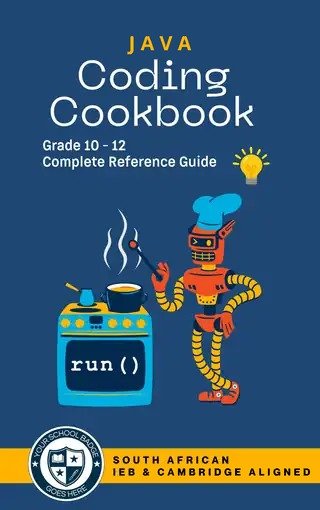
A complete Java reference for learners in Grades 10 to 12 (IEB) or Years 10 to 13 (Cambridge), and for the teachers who teach them. It assumes no programming experience, and explains each topic in simple language with short examples to type in and run.
Book details
- Pages: 302
- Chapters: 33
- Level: Grade 10–12 / Year 10–13
- Curriculum: IEB and Cambridge
- Formats: print-ready PDF, EPUB and digital PDF
Who it is for
- IEB Information Technology: schools choose Delphi, Java or C#. The book covers the practical exam (Paper 1), with its SQL section and console Java section built on object-oriented programming and text files, as well as Paper 2 algorithms and the PAT.
- Cambridge IGCSE (0478) and AS & A Level (9618) Computer Science: IGCSE is examined on paper in pseudocode, so Java is how learners practise; A Level Paper 4 is a practical exam that can be written in Java.
Where the IEB and Cambridge differ, the book says so in the section concerned.
What the book covers
33 chapters in seven parts, three appendices and a glossary.
| Part | Chapters | What it covers | Most useful for |
|---|---|---|---|
| 1. The basics | 1–10 | Getting started, data types, variables, input and output, operators, strings, conditions, selection, loops and random numbers | Everyone |
| 2. Arrays and collections | 11–14 | Arrays, 2D arrays, ArrayList, HashMap and records | IEB Paper 1; Cambridge Papers 2 and 4 |
| 3. Organising code | 15–19 | Methods, packages and the Java API, exceptions, validation and recursion | Everyone; recursion is an A Level topic |
| 4. Algorithms | 20 | Linear and binary search, bubble, selection and insertion sort | IEB Paper 1; Cambridge Papers 2 and 4 |
| 5. Files, databases and dates | 21–24 | Text files, SQL, databases with JDBC, dates and times | IEB Paper 1 and the PAT; Cambridge file handling |
| 6. Object-oriented programming | 25–30 | Classes, encapsulation, toString, equals and compareTo, inheritance, abstract classes, interfaces and polymorphism | IEB Paper 1; Cambridge A Level |
| 7. Abstract data types | 31–33 | Stacks, queues, linked lists and binary trees | Cambridge AS & A Level |
- Appendix A: debugging, trace tables, testing and good style.
- Appendix B: Cambridge pseudocode translated into Java.
- Appendix C: an optional introduction to graphical interfaces with Swing, useful for an IEB PAT.
- Glossary: every technical term in plain language.
How each chapter works
- Introduction: what the topic is and why it matters.
- Numbered sections: one idea at a time, with code to type in and run, and the output it prints.
- Worked examples: small, complete programs that bring the ideas together.
- Common mistakes: the errors learners make most often, what goes wrong and how to fix it.
- Check yourself: short questions with the answers straight after them.
The book also includes a guide for teachers on planning, classroom activities and practical work, a guide for learners on study habits and exam preparation, and suggested routes through the book.
Software
Java 21 (any version from Java 17 runs the examples), with the free JDK and an editor such as NetBeans, IntelliJ IDEA, VS Code or BlueJ. Names follow the standard Java conventions that markers expect.
Practice data pack
- Text files in the IEB format, with fields split by #, including a deliberately messy file for validation practice
- SQLite databases that match the SQL chapters, a MySQL script, and CSV files to import into MS Access
- A working starter program and a list of practice tasks
Your school’s edition
Your school badge goes on the cover, and you receive the Java Coding Cookbook as a print-ready PDF, an EPUB and a digital PDF, with the practice data pack. Your licence lets you print, share and resell the book to your own learners. See how licensing works.